

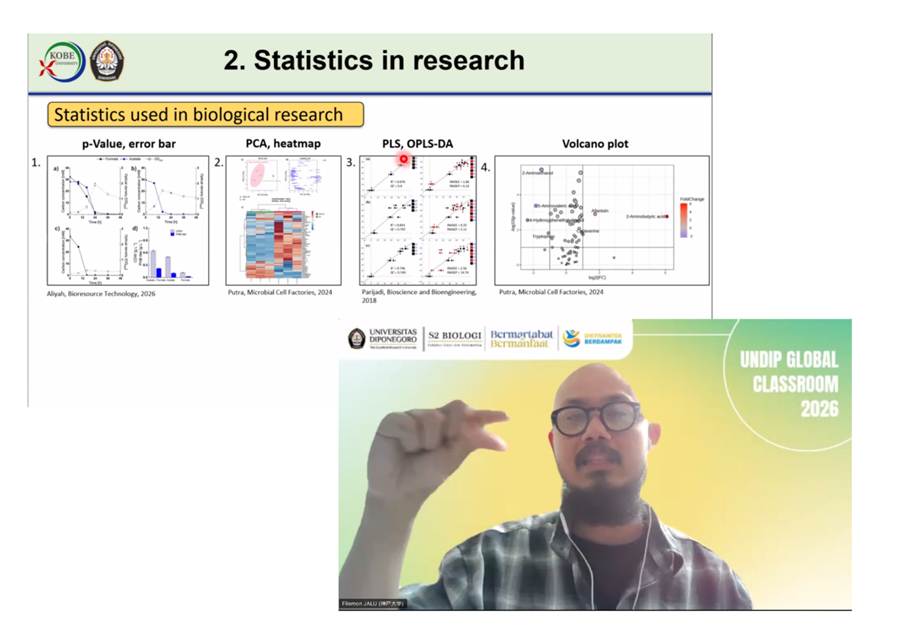
As research methodologies continue to evolve in the digital era, the Master’s Program in Biology, Faculty of Science and Mathematics (FSM), Universitas Diponegoro (UNDIP), remains committed to equipping students with the latest scientific approaches through the Undip Global Classroom (UGC) program. As part of this initiative, the program organized another International Lecture Series featuring an Indonesian researcher based in Japan, who shared insights into the application of omics technologies, bioinformatics, and artificial intelligence (AI) in modern biological research.
Integrated into the Research Methodology course, the lecture series featured Dr. Eng. Filemon Jalu N. Putra from Kobe University, Japan, as the keynote speaker. Dr. Jalu is recognized for his interdisciplinary research in bioinformatics, omics, data science, and the application of AI to biological data analysis. Drawing on his international research experience and collaborations, he highlighted the ongoing transformation of biological research methodologies, where computational technologies and data-driven approaches are becoming increasingly essential for addressing complex biological questions.
The International Lecture Series consisted of two sessions. The first lecture, “Experimental Design, Statistics & Reproducibility in Modern Biology,” was held on April 23, 2026. The second session, titled “Omics, Integrating AI & Data-Driven Approaches in Biological Research,” took place on May 1, 2026. Both sessions were moderated by Prof. Dr. Erma Prihastanti, the lecturer for the Research Methodology course in the Master’s Program in Biology at Universitas Diponegoro.
During the first session, Dr. Jalu emphasized the importance of developing well-structured research designs, applying appropriate statistical methods, and ensuring reproducibility as the foundation of high-quality scientific research. The second lecture focused on recent advances in omics technologies and the integration of artificial intelligence for analyzing large-scale biological datasets. Through practical examples, he demonstrated how data-driven approaches can improve analytical efficiency while generating more accurate and comprehensive scientific insights.
The lectures were highly interactive, with participants actively engaging in discussions on the application of AI in genomic analysis, multi-omics data integration, and the challenges of maintaining research validity and reproducibility in the era of big data. These discussions provided students with valuable perspectives on the growing importance of digital and computational skills in contemporary biological research.
In addition to students from the Master’s Program in Biology at Universitas Diponegoro, the event was attended by lecturers, researchers, and students from various universities with interests in research methodology, bioinformatics, and computational biology. The participation of attendees from diverse institutions enriched the exchange of ideas and fostered meaningful academic interaction throughout the lecture series.
Through the International Lecture Series, the Master’s Program in Biology at Universitas Diponegoro continues to strengthen a learning environment that adapts to rapid developments in science and technology. Collaborations with international academics and researchers are expected to broaden students’ scientific perspectives, enhance their research capabilities, and create opportunities for future collaborations that drive innovation in the biological sciences.