
The Master’s Program in Biology, Faculty of Science and Mathematics (FSM), Universitas Diponegoro (UNDIP), through its Cluster for Paleolimnology (CPalim), once again organized an International Lecture Series as part of the Undip Global Classroom (UGC) program. The event served as an international scientific forum highlighting the application of DNA metabarcoding as an advanced approach for coastal ecosystem biomonitoring and biodiversity conservation.
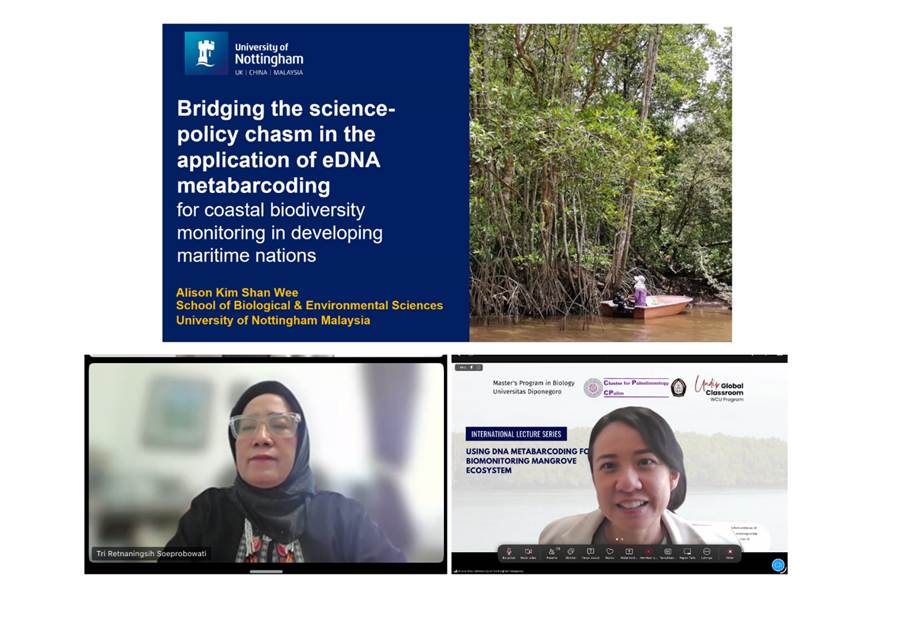
The lecture series featured Assoc. Prof. Dr. Alison Kim Shan Wee from the University of Nottingham Malaysia as the keynote speaker. Dr. Alison specializes in molecular ecology, DNA metabarcoding, environmental DNA (eDNA), and mangrove ecosystem conservation. The program also featured Prof. Dr. Tri Retnaningsih Soeprobowati, a faculty member of the Department of Biology at FSM UNDIP and Head of CPalim, as a co-lecturer, sharing her expertise in aquatic ecology, biomonitoring, and environmental management.
The International Lecture Series was conducted in two sessions. The first lecture, “Using DNA Metabarcoding for Biomonitoring Mangrove Ecosystem,” was held on April 20, 2026, while the second session, “Bridging the Science–Policy Chasm in the Application of Environmental DNA Metabarcoding for Coastal Biodiversity Monitoring in Developing Maritime Nations,” took place on April 27, 2026.
During the first session, Dr. Alison introduced the fundamental concepts and applications of DNA metabarcoding for rapidly and accurately assessing biodiversity within mangrove ecosystems. She explained how this technology offers a powerful and efficient tool for ecosystem biomonitoring, supporting biodiversity conservation and sustainable coastal resource management. In the second lecture, the discussion focused on the challenges of translating environmental DNA (eDNA)-based research into environmental policy and management practices. Dr. Alison emphasized the importance of strengthening collaboration among researchers, government agencies, and other stakeholders to facilitate the implementation of biomonitoring technologies in developing maritime nations.
The lecture series generated enthusiastic participation, with lively discussions on the potential application of DNA metabarcoding in Indonesia, advances in eDNA-based biomonitoring methods, and the challenges of integrating these technologies into mangrove conservation and coastal management programs. In addition to students from the Master’s Program in Biology at FSM UNDIP, the event attracted lecturers, researchers, students from various universities, and environmental practitioners with interests in molecular ecology and biodiversity conservation.
Through this International Lecture Series, the Master’s Program in Biology at FSM UNDIP continues to strengthen international academic collaboration while providing learning opportunities that reflect the latest developments in biological sciences. The partnership with the University of Nottingham Malaysia and CPalim is expected to foster international research collaborations and enhance students’ academic competencies in biomonitoring, molecular biology, and coastal ecosystem conservation.