
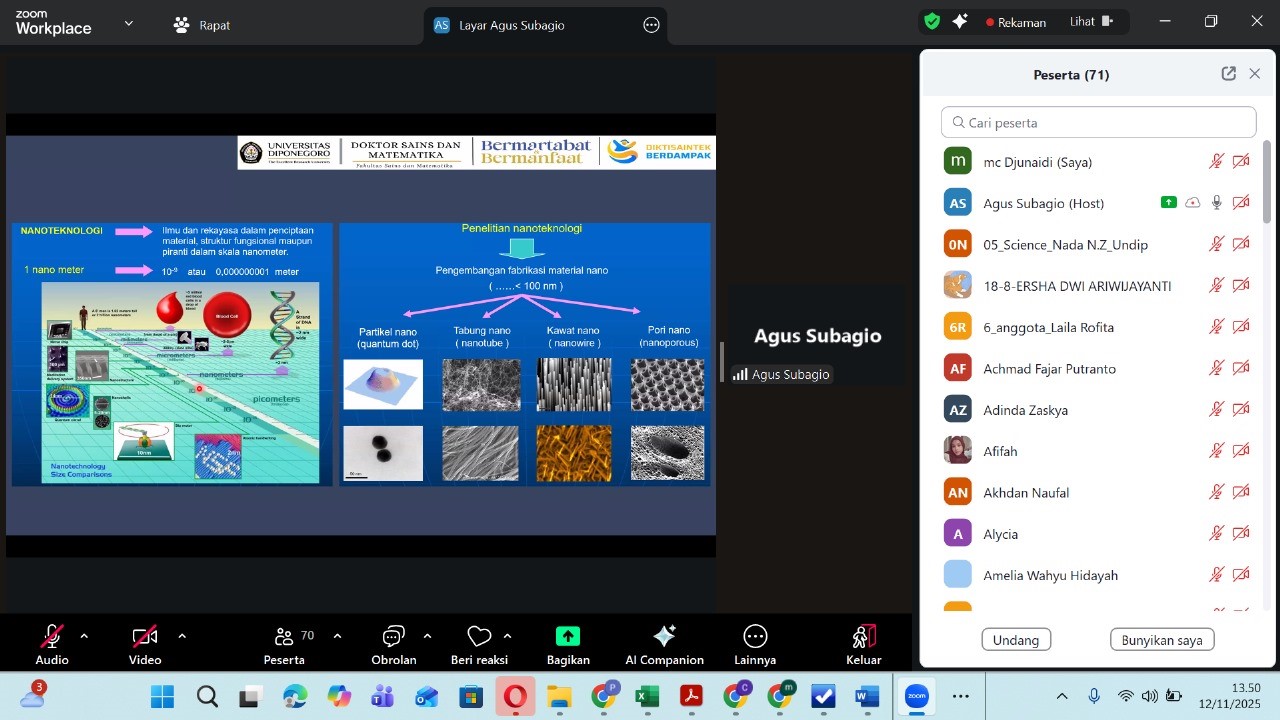
Semarang, 12 November 2025 – The Doctoral Program in Science and Mathematics (DSM), Faculty of Science and Mathematics, Diponegoro University held a webinar entitled “Nanotechnology for Indonesia.” This research sharing session presented Prof. Dr. Agus Subagio, S.Si, M.Si (Professor of the DSM Program) as speaker, with Prof. Dr. M. Cholid Djunaidi, M.Si, S.Si (Professor of the DSM Program) as moderator. The event was conducted online via Zoom on Wednesday, 12 November 2025.
In his presentation, Prof. Agus Subagio began with an introduction to nano carbon, which has high mechanical strength, good chemical stability, and superior durability and flexibility compared to conventional carbon materials. Various forms of carbon nanomaterials, such as graphene, carbon dots, and carbon nanotubes (CNT), were discussed along with their characteristics. CNTs with single-walled structures (SWCNT) and multi-walled structures (MWCNT) were reviewed as highly conductive materials that are potential nanofillers in the development of electronic components. Prof. Agus also highlighted the innovation of Graphene Mesosponge (GMS) developed by the start-up 3DC in Japan, a 3D carbon material with mesoporous structure that offers a large surface area, high elasticity, and excellent electrical conductivity for applications in supercapacitors, fuel cells, and future energy catalysts.
The discussion then moved to the development of nano-scale semiconductor devices in line with rapid technological miniaturization. Using the example of the start-up MNT, he explained the development of high-precision nanomanipulators, nanotransistors, ultra-dense memories, and compact microprocessors that enable high-speed computing in ever-smaller dimensions. Prof. Agus also underlined the role of the start-up QDI (Quantum Dot Industries), which produces lead sulfide (PbS)-based quantum dots. These quantum dots have high attenuation capability, resulting in better resolution and contrast in X-ray imaging and supporting the production of high-resolution medical imaging sensors and devices with lower radiation doses.
The next theme was green nanotechnology, which emphasizes the shift from combustion-based processes to more environmentally friendly and energy-efficient nanoparticle synthesis. Biofabrication approaches using biological resources were introduced as an alternative to synthetic materials that have the potential to reduce environmental impact. As a case study, he presented the start-up Nanomatics from Singapore, which processes plastic waste through pyrolysis and CVD to produce MWCNT while simultaneously generating oil and hydrogen, thereby contributing to carbon footprint reduction.
Prof. Agus also discussed nanocomposites, namely composite materials combining polymer, metal, or ceramic matrices with nanoparticles to enhance mechanical, thermal, and chemical properties. Rapidly developing examples include Metal–Organic Frameworks (MOF), Carbon Fiber Reinforced Polymer (CFRP), and nano-ceramics, which are widely used in the automotive and aerospace industries because they are strong, lightweight, and heat-resistant. Global market data show that the nanocomposite industry is projected to grow significantly to more than USD 24 billion by 2032. As an applied illustration, the start-up Xheme in the United States has developed patented blood bags and tubes made from polymer nanocomposites that are free from plasticizers and harmful additives, making them safer for medical applications.
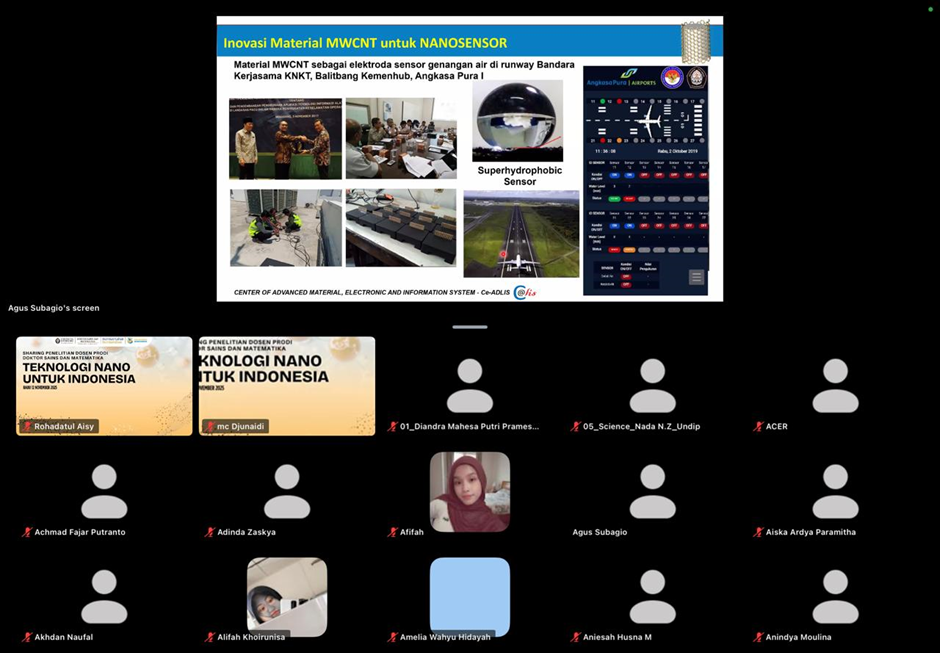
In the field of sensors, nanosensors were introduced as nanometer-scale detection devices capable of recognizing chemical, physical, or biological changes at the molecular level. Nanosensors play an important role in health, environmental, energy, defense, and industrial monitoring. The global nanosensor market is projected to continue growing in line with the increasing need for more accurate, sensitive, and miniaturized detection systems. Various types of electrochemical and mechanical nanosensors are being developed for disease detection, glucose monitoring, air and water pollutant surveillance, and monitoring reactions in fuel cells.
The final session highlighted the use of nanomaterials in the energy sector. Nanotexturing on battery components, supercapacitors, and other energy-storage devices can increase active surface area, conductivity, and charge–discharge cycle stability. Prof. Agus gave examples such as graphene aerogel, ZnO nanowires, and nanofiber-based cathode materials like NiS nanoflakes grown on carbon nanofibers. Electrospinning technology was explained as an important technique for producing ultra-fine nanofibers that can enhance the capacity and efficiency of energy storage. Globally, the energy nanotechnology market also shows an upward trend with relatively high growth projections in the coming years.
Through the “Nanotechnology for Indonesia” event, the Doctoral Program in Science and Mathematics, FSM UNDIP reaffirmed its commitment to promoting nanotechnology research that is not only excellent academically but also relevant to national needs in the energy, environmental, health, and industrial sectors. It is hoped that cross-disciplinary collaboration and synergy with industry and nanotechnology-based start-ups will continue to be strengthened so that the research outputs of DSM FSM UNDIP’s academic community become increasingly dignified and beneficial for Indonesia.