
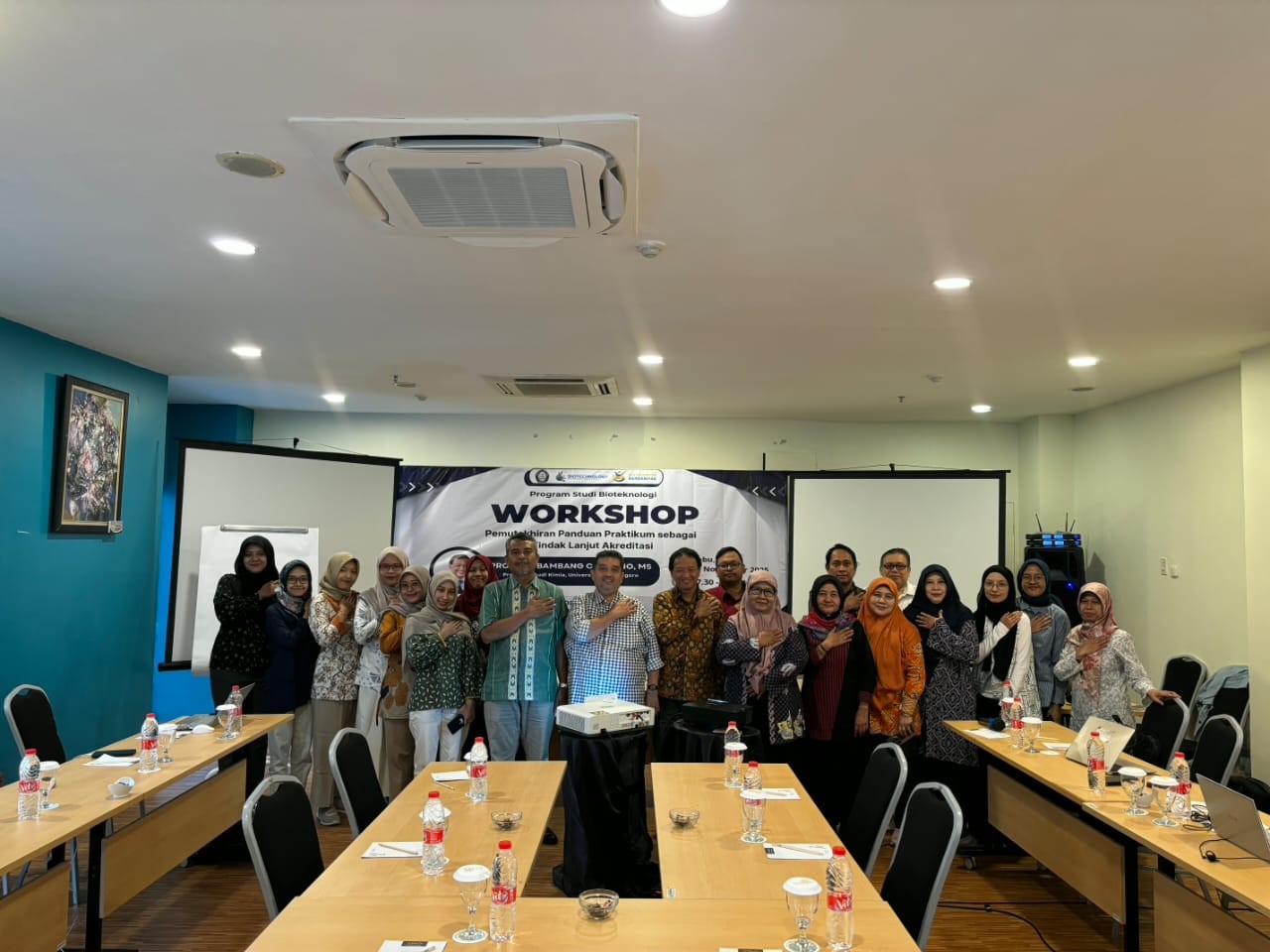
Semarang, 26 November 2025 – The Biotechnology Study Program, Faculty of Science and Mathematics, Diponegoro University, held the Biotechnology Practicum Module Updating Workshop 2025 as a strategic step to strengthen the quality of laboratory-based learning. The activity, attended by all lecturers and educational staff, focused on reviewing the structure of practicums, aligning learning outcomes, and designing modules that are more adaptive to the rapid development of biotechnology.
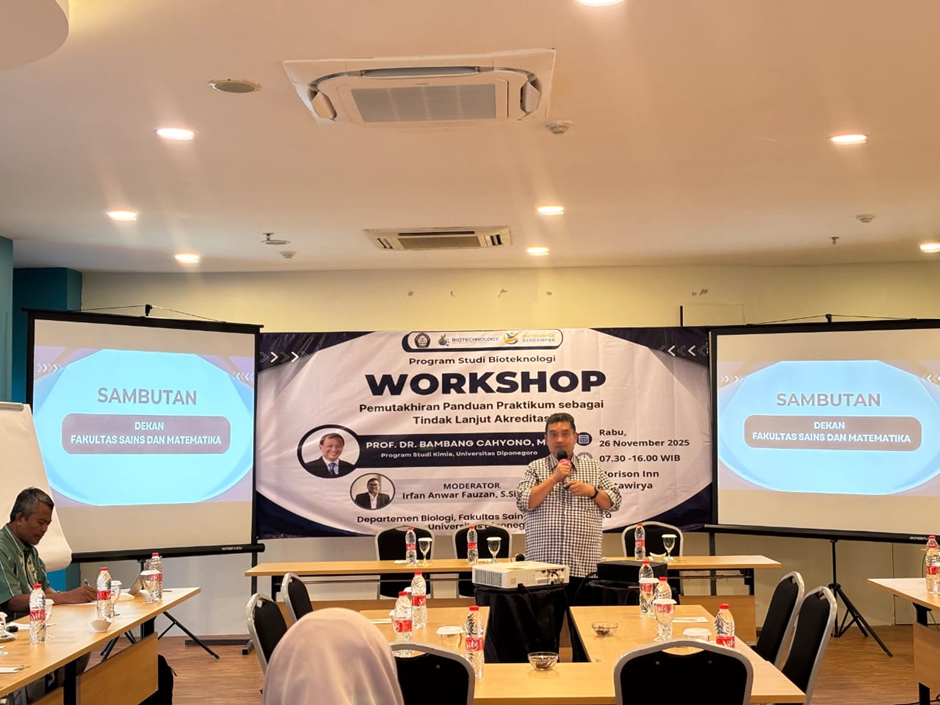
The workshop was led directly by the Head of the Biotechnology Study Program, Dr. Sri Pujiyanto, S.Si., M.Si. In his remarks, he emphasized that updating practicum modules is key to ensuring that biotechnology graduates possess relevant competencies and are ready to face challenges in both the professional and research worlds. The activity also received full support from the Dean of the Faculty of Science and Mathematics UNDIP, Prof. Dr. Kusworo Adi, S.Si., M.T., who officially opened the event and delivered directions on the importance of continuous improvement in practicum management.

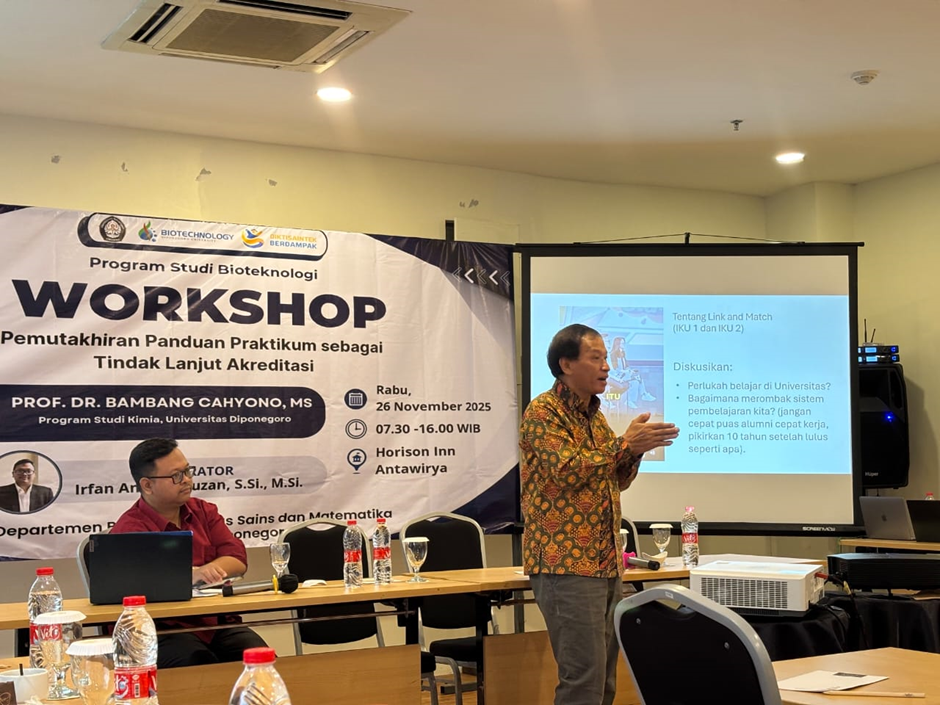
To strengthen the academic substance, the workshop was moderated by Irfan Anwar Fuzan, S.Si., M.Si., and featured Prof. Bambang Cahyono, MS as the main speaker. Prof. Bambang delivered a comprehensive explanation of the principles for preparing the Semester Learning Plan (RPS) and practicum modules that are aligned with curriculum standards. The materials presented provided a systematic guide for lecturers in designing practicums that are measurable, well-directed, and oriented toward competency achievement, so that the resulting modules are not only administratively neat but also strong in terms of substance.
This workshop became even more special as it coincided with the latest achievement of the Biotechnology Study Program, which had just earned “Unggul” (Excellent) Accreditation from LAMSAMA on 24 November 2025. This recognition has become a positive driving force for the academic community to continuously strengthen the quality of learning, both in theoretical aspects and in practical skills. The updating of practicum modules is positioned as one of the concrete commitments to maintaining and raising quality standards following this accreditation achievement.
In line with the module development, the Biotechnology Study Program has also significantly upgraded its laboratory facilities. Various new instruments have been added to the practicum rooms, including a Real-Time PCR, NanoDrop Spectrophotometer, Vertical Electrophoresis, Refrigerated Centrifuge, Microplate Reader, room-temperature Microcentrifuge, Spin Down, Horizontal Electrophoresis, 10 L Bioreactor, Spray Dryer, Stereo Microscope, Freeze Dryer, and Ultrasonic Homogenizer. The presence of these instruments enables students to experience a more contextual practicum process, closely reflecting current biotechnology research and industrial practices.
With these enhanced facilities, the updated practicum modules are expected not only to be more up-to-date in terms of content but also to provide hands-on experiences that are relevant to the needs of the workforce and research development. Students can train using the same technologies applied in research laboratories and industry, thereby strengthening their competency readiness when entering the professional world.
Through the implementation of this workshop, the Biotechnology Study Program reaffirms its commitment to delivering high-quality and sustainable education—learning that not only conveys concepts, but also enables students to practice, experiment, and innovate.