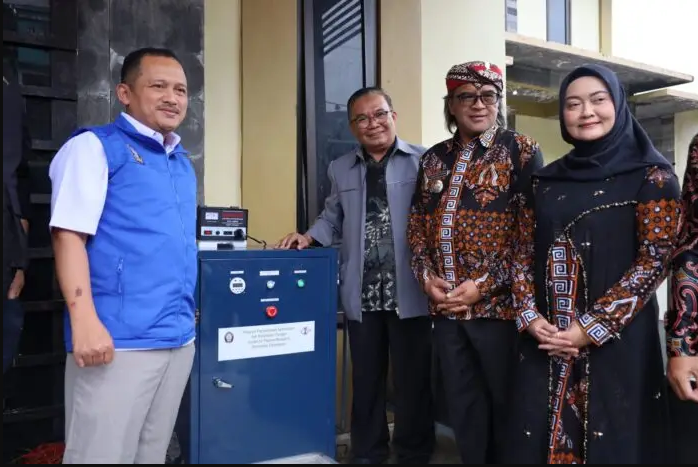
Diponegoro University, through the Institute for Research and Community Service (LPPM), handed over agricultural technology innovations in the form of ozone plasma and solar dryer devices to the Temanggung Regency Government. The handover ceremony took place at the Campurejo Village Hall, Tretep District, on Tuesday, 21 January 2026, and was attended by local government officials, members of the regional parliament, and community representatives.
This initiative serves as an implementation of the Tri Dharma of Higher Education, particularly in the field of community service, aimed at strengthening rural food security, increasing post-harvest efficiency, and creating economic opportunities through value-added agricultural commodities. The Faculty of Science and Mathematics (FSM) Undip played a role in the program through research downstreaming and technological development that can be applied directly in the field.
Chairman of LPPM Undip, Prof. Dr. Ing. Suherman, S.T., M.T., emphasized that Undip continues to encourage the development of applied research that responds to real societal needs. The program in Temanggung represents part of the university’s efforts to address food security and poverty alleviation through technological innovation, including those originating from FSM Undip.
One of the technologies handed over was the ozone plasma device developed by Prof. Dr. Muhammad Nur, DEA from the Department of Physics, FSM Undip. The device is designed to extend the shelf life of vegetables and horticultural products, such as chili peppers that typically last only a few days but can remain fresh for more than a week after ozone treatment. When combined with cold storage systems, the shelf life can reach two to three months, giving farmers more flexibility in selling their produce at more stable prices.
In addition to extending storage duration, ozone plasma technology also helps reduce spoilage and pesticide residues on agricultural products. These advantages support improvements in product quality for entry into modern markets, while simultaneously reducing post-harvest food loss—a persistent challenge in the agricultural sector.
Furthermore, Undip also handed over a solar dryer developed by Prof. Suherman from FSM Undip. The device utilizes a hybrid system combining solar energy and infrared to accelerate the drying process of commodities such as coffee, corn, and rice. This technology is considered effective, particularly during the rainy season, as it allows agricultural products to maintain their quality without relying solely on traditional sun-drying methods.
The Regent of Temanggung, Agus Setyawan, expressed his appreciation for Undip’s contribution in supporting the development of an agriculture-based local economy. He noted that the technologies provided were relevant to the potential of Campurejo Village, which has diverse agricultural commodities that can be developed into higher value products.
At the initial stage, one unit of the device has been handed over while the remaining units are still being completed. Through this program, FSM Undip demonstrates its contribution to the downstreaming of scientific and technological research that supports increased agricultural productivity and community welfare.
Moving forward, Undip hopes that the application of ozone plasma and solar dryer technologies can be expanded to more regions and serve as a model for collaboration between universities, local governments, and communities in strengthening national food security. FSM Undip is optimistic that continuous innovation in research and technology can support the growth of agriculture-based regional economies and provide tangible benefits to society.
News reference:
Jateng News (26 January 2026)
https://www.jatengnews.id/2026/01/26/undip-serahkan-teknologi-plasma-ozon-dan-pengering-surya-ke-pemkab-temanggung/