
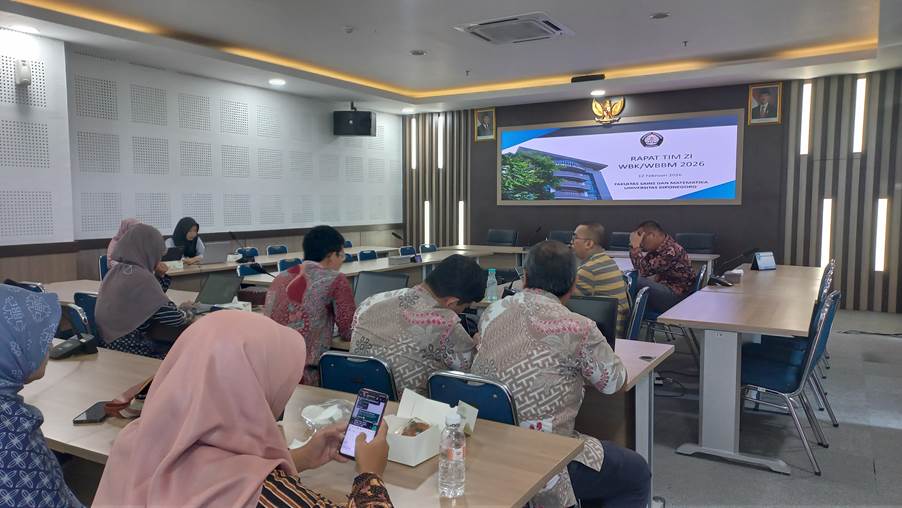
The Faculty of Science and Mathematics, Universitas Diponegoro, held a coordination meeting on the development of the Integrity Zone (ZI) on Thursday, 12 February 2026, at the 4th Floor of Acintya Prasada Building, FSM UNDIP. The meeting was attended by the ZI development team from the six Areas of Change Drivers as part of strengthening a shared commitment to achieving transparent, accountable, and service-oriented faculty governance.
The meeting focused on progress presentations delivered by each Area of Change Driver coordinator. This forum served as a coordination platform to ensure that all programs are aligned and support the achievement of the Integrity Zone targets toward a Corruption-Free Area (WBK) and a Clean and Serving Bureaucratic Area (WBBM).
During the presentation of the Change Management Area, updates were delivered regarding the preparation and uploading of supporting documents that have been completed. In addition, plans to strengthen the promotion of an integrity culture were discussed through the addition of information media such as banners and Integrity Zone signage within the faculty environment to raise awareness among the entire academic community.
Meanwhile, the Internal Control and Monitoring Area presented the development of the ZI WBBM risk map. This document is an essential component in fulfilling the requirements of the Integrity Zone Evaluation Worksheet (LKE) and represents a systematic effort to identify potential risks and formulate appropriate mitigation strategies.
In addition to these areas, all Areas of Change Drivers shared their progress and follow-up plans for their respective work programs. The discussion was dynamic and focused on aligning targets, strengthening collaboration, and accelerating the completion of the required supporting documents for the Integrity Zone development process at FSM UNDIP.
Through this coordination meeting, FSM UNDIP reaffirmed its commitment to strengthening synergy across all Areas of Change Drivers, maintaining consistent program implementation, and continuously improving faculty governance. This collective effort is expected to foster a professional, clean, and service-oriented working environment for the community.