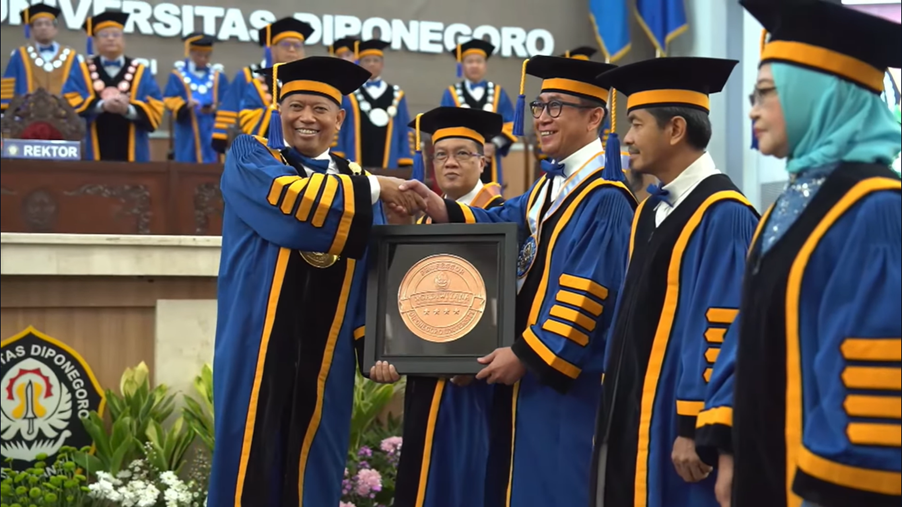
The Faculty of Science and Mathematics (FSM), Diponegoro University held an Academic Senate Open Session for the Conferment of Professorship at the Prof. Soedarto Hall, Diponegoro University. The ceremony was attended by university leaders, faculty members, students, and invited guests, and was broadcast live through the Undip TV Official YouTube channel.
On this occasion, FSM conferred the title of Professor upon Prof. Dr. Ngadiwiyana, S.Si., M.Si. in the field of Organic Compound Modification and Polymer Chemistry. He is a faculty member at the Department of Chemistry and has made consistent contributions to the development of environmentally friendly polymer materials.
Prof. Ngadiwiyana obtained his bachelor’s and master’s degrees in Chemistry from Universitas Gadjah Mada, and earned his doctoral degree in Chemical Engineering from Diponegoro University. Throughout his academic career, he progressed through several academic ranks—from Assistant Professor (2002), Associate Professor (2007), Senior Associate Professor (2013), and was ultimately inaugurated as Full Professor in 2025. He has authored academic books, published numerous articles in national and international journals, and produced intellectual property supporting research innovation within the Department of Chemistry at FSM UNDIP.
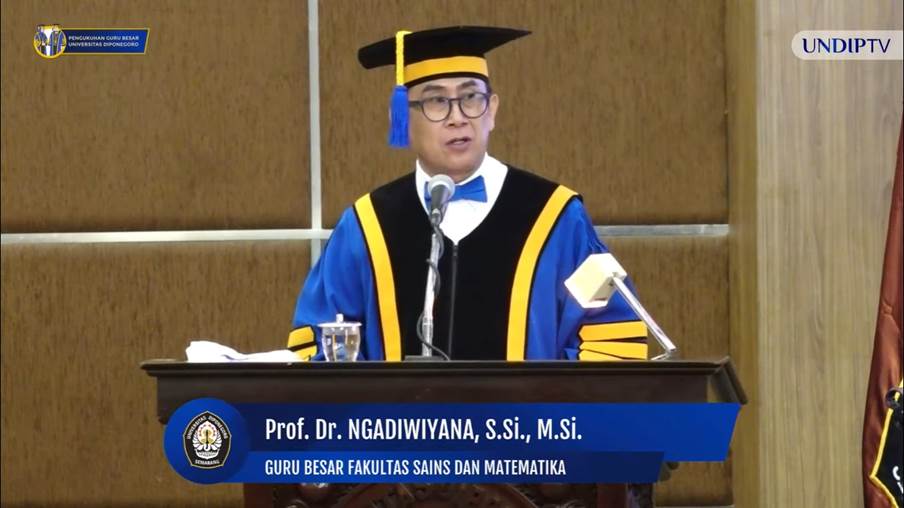
In his inaugural scientific oration titled “Transformation of Eugenol from Clove Oil into Functional Organic Polymers as Environmentally Friendly Coating Materials to Support Sustainable Development,” Prof. Ngadiwiyana highlighted global challenges related to the dependence on petroleum-based polymers that are difficult to degrade and contribute significantly to carbon emissions. According to him, utilizing renewable biomass—particularly eugenol extracted from clove oil—offers new opportunities for developing high-performance and sustainable materials.
Indonesia is one of the world’s largest producers of cloves, yet research and industrial downstreaming of clove-based products remain limited compared to other countries. Through green chemistry approaches, eugenol can be transformed into functional organic polymers with antibacterial, antioxidant, and anti-corrosion properties. These characteristics make eugenol-based polymers highly promising for applications in health industries, food packaging, and metal coating. Moreover, biomass-based polymer development supports sustainability agendas and carbon reduction efforts aligned with the Sustainable Development Goals (SDGs).
Prof. Ngadiwiyana emphasized that collaboration between research institutions, industry, and government is essential to advance biomass material downstreaming and strengthen standardization and regulatory frameworks. Optimizing local natural resources through sustainable polymer innovation is expected to serve as a strategic contribution to enhancing Indonesia’s competitiveness in advanced material technologies.
FSM UNDIP expresses its appreciation for this achievement and hopes that the conferment of this Professorship will further strengthen academic contributions, research excellence, and scientific development at national and international levels, particularly in the fields of material chemistry and sustainable technologies.