

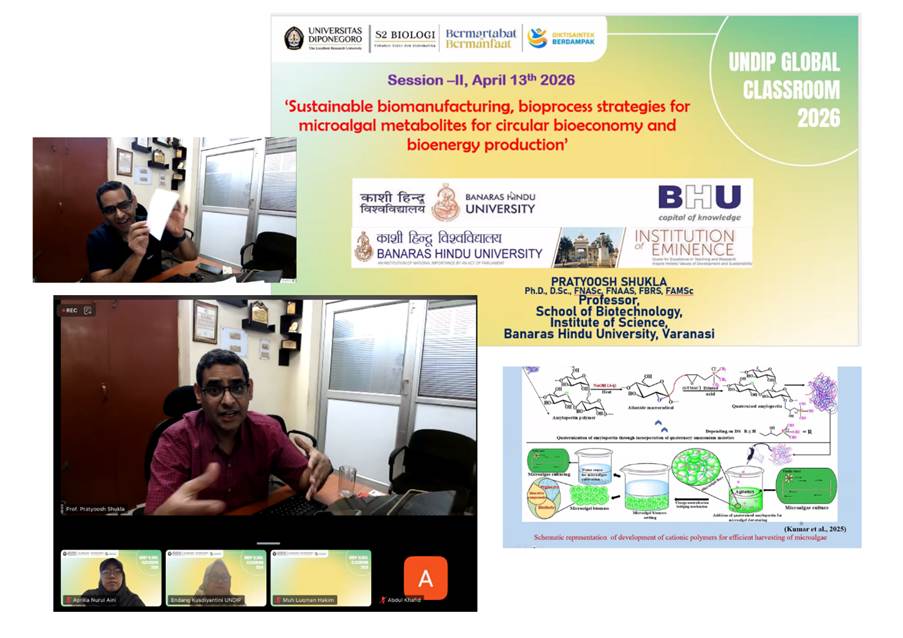
The Master’s Program in Biology, Faculty of Science and Mathematics (FSM), Universitas Diponegoro (UNDIP), reaffirmed its commitment to delivering internationally oriented education by organizing another International Lecture Series as part of the Undip Global Classroom (UGC) program. Integrated into the Bioprocess course, the program featured Prof. Pratyoosh Shukla, a distinguished professor from Banaras Hindu University, India, who shared the latest developments in industrial biotechnology and sustainable bioprocess strategies.
Prof. Shukla is internationally recognized for his expertise in industrial biotechnology, microbial biotechnology, enzyme technology, bioenergy, and biorefinery. Through his extensive scientific publications and international research collaborations, he has made significant contributions to the development of microorganism-based technologies that promote more efficient, environmentally friendly, and sustainable industrial processes.
The International Lecture Series was conducted in two sessions. The first session, titled “Microbial Bioprocesses Optimization and Innovative Enzyme Technology for Futuristic Applications,” was held on April 4, 2026. The second session, “Sustainable Biomanufacturing: Bioprocess Strategies for Microalgal Metabolites for Circular Bioeconomy and Bioenergy Production,” took place on April 13, 2026. Both sessions were facilitated by Prof. Dr. Dra. Endang Kusdiyantini, DEA., who serves as the Bioprocess course lecturer in the Master’s Program in Biology at Universitas Diponegoro.
During his presentations, Prof. Shukla highlighted the importance of optimizing microbial bioprocesses and advancing enzyme technologies as key drivers of future biotechnology industries. He also discussed innovative strategies for producing microalgal metabolites with potential applications in bioenergy production and other high-value bioproducts. Emphasizing the growing significance of circular bioeconomy principles, he explained how integrating sustainable bioprocess technologies can help address global challenges related to energy security, waste management, and the sustainable utilization of biological resources.
The lecture series generated enthusiastic participation, with lively discussions covering topics such as the industrial application of microorganisms, enzyme engineering to improve production efficiency, and the challenges of implementing sustainable biomanufacturing in developing countries. The discussions reflected students’ strong interest in research that connects biotechnology innovations with industrial needs and sustainable development.
In addition to students from the Master’s Program in Biology at Universitas Diponegoro, the event was attended by lecturers, researchers, and participants from various universities and institutions interested in biotechnology and bioprocess engineering. The diverse academic backgrounds of the participants created a valuable platform for scientific exchange and fostered opportunities for future research collaboration.
Through the International Lecture Series, the Master’s Program in Biology at Universitas Diponegoro continues to strengthen the implementation of the Undip Global Classroom (UGC) as a platform that connects students with internationally recognized academics and researchers. The program is expected to broaden students’ scientific perspectives, enhance the quality of learning, and promote international research collaborations that support future advances in biotechnology and sustainable innovation.