
Two undergraduate students from the Physics Study Program, Diponegoro University, class of 2022, who graduated in early May 2026, are now at the beginning of a new and more challenging journey. Equipped with experience in using the Monte Carlo N-Particle (MCNP) method in nuclear physics studies, both have built a strong foundation to enter the field of international research. They were specifically invited to have a discussion with Prof. Muhammad Nur regarding the next strategic steps in the development of science and technology.
Pato Sayyaf, 18 years old, is the youngest graduate of Diponegoro University in this graduation period. Pato has focused on medical applications, particularly Boron Neutron Capture Therapy (BNCT). Meanwhile, Muhammad Zidni, 22 years old, who has long focused on the design and analysis of Small Modular Reactors (SMR), is becoming increasingly determined to deepen his expertise in this field at the next level of education.
During our discussion, both agreed that the future of clean, efficient, and safe energy is closely related to SMR technology. This type of reactor is considered to have advantages in terms of flexibility, construction costs, and better passive safety systems compared to conventional reactors. Therefore, pursuing further studies abroad is seen as a strategic step to access more advanced research facilities, global academic networks, and guidance from experts in nuclear technology.
They are currently preparing various requirements, ranging from foreign language proficiency and research proposal development to selecting universities with a strong focus on next-generation reactor technology. Countries with well-established traditions in nuclear research have become their main destinations, particularly those that have already developed and comprehensively tested SMR concepts.
In the discussion, which was also attended by Pato Sayyaf’s parents, it was agreed that the two Physics graduates would pursue Small Modular Reactor studies in Russia. This decision is quite reasonable, and even strategic, when viewed from the current global landscape of nuclear technology. Russia, through Rosatom, is one of the most active players in the development and implementation of SMR technology, both for domestic use and export.
One of the main advantages of studying there is proximity to real projects. Russia does not merely develop concepts on paper; it has already operated modular reactors such as the Akademik Lomonosov, a floating nuclear power plant that serves as concrete evidence of SMR implementation. This provides students with the opportunity to understand not only theoretical aspects, but also engineering, safety, and operational challenges in real-world settings.
However, this decision also needs to be viewed critically. The current geopolitical environment may affect access to international collaboration, publications, and academic mobility. In addition, reactor design standards and approaches in Russia sometimes differ from those used in Western countries. This could become both a challenge and an opportunity, depending on how they make use of it.
Academically, Russia has a strong tradition in nuclear physics and reactor engineering. Institutions there are known for their solid foundation in theory and computation, which is highly relevant to their background in simulations using MCNP. If they are able to combine this analytical strength with practical experience in SMR projects, they could develop into globally competitive researchers or engineers.
It is hoped that after completing their advanced studies, both will return to Indonesia and contribute to the development of safe and sustainable nuclear energy technology. As national energy demand continues to increase, the presence of competent human resources in this field will become an important asset in supporting the country’s future energy transition.
The step they are taking today is not only about personal achievement, but also part of a long-term effort to provide energy solutions for future generations.
Semarang, May 6, 2026
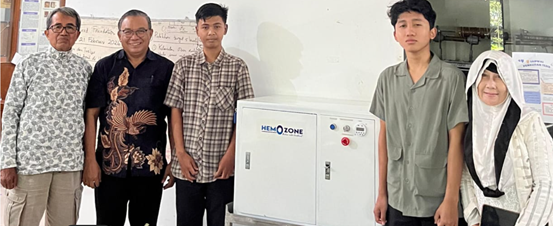
The photo below shows, from right to left: Pato Sayyaf’s father, Prof. Nur, Muhammad Zidni, Pato Sayyaf, and Pato Sayyaf’s mother.