
As part of its commitment to providing education that keeps pace with global scientific advancements, the Master’s Program in Biology, Faculty of Science and Mathematics (FSM), Universitas Diponegoro (UNDIP), continues to organize international academic activities through the Undip Global Classroom (UGC) program. The latest International Lecture Series featured an international expert who shared insights into innovations in applied physiology, with a particular focus on plant biotechnology and the use of microalgae as sustainable solutions.
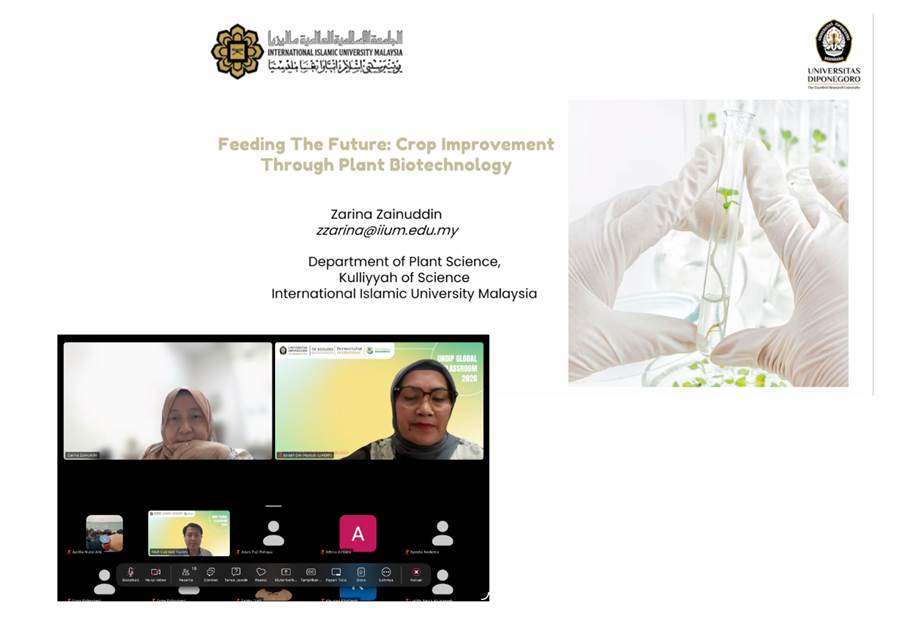
Integrated into the Applied Physiology course, the lecture series welcomed Assoc. Prof. Dr. Zarina Binti Zainuddin from the International Islamic University Malaysia (IIUM) as the keynote speaker. Dr. Zarina specializes in plant biotechnology, plant physiology, and the application of microalgae for food, energy, and bioindustry. Her research focuses on developing biotechnological approaches to improve crop productivity while promoting the sustainable utilization of biological resources.
The program consisted of two lecture sessions. The first session, titled “Crop Improvement through Plant Biotechnology,” was held on May 5, 2026, followed by the second session, “Sustainable Solutions through Microalgae: Energy, Food and Beyond,” on May 12, 2026. Both sessions were moderated by Prof. Endah Dwi Hastuti, M.Si., the lecturer for the Applied Physiology course in the Master’s Program in Biology at Universitas Diponegoro.
During her presentations, Dr. Zarina introduced a range of biotechnological approaches currently used to enhance crop quality and productivity, including plant tissue culture techniques and strategies for developing improved crop varieties that are better adapted to changing environmental conditions. She also discussed the growing potential of microalgae as a renewable source of biomass for producing functional foods, biofuels, animal feed, and other value-added bioproducts. These topics highlighted the increasingly important role of biotechnology in supporting food security and sustainable development.
The lectures were marked by active participation and engaging discussions. Participants raised questions about the application of biotechnology to address climate change, the development of crops with greater tolerance to environmental stress, and the challenges of commercializing microalgae-based products. These discussions provided students with a broader understanding of current research trends in plant physiology and biotechnology while exposing them to emerging opportunities in the field.
In addition to students from the Master’s Program in Biology at Universitas Diponegoro, the event attracted lecturers, researchers, and participants from various universities and institutions with interests in plant physiology, biotechnology, and the bioindustry. The diverse audience created a valuable forum for exchanging ideas and strengthening academic networks across institutions.
Through this International Lecture Series, the Master’s Program in Biology at Universitas Diponegoro continues to strengthen its commitment to internationally oriented education that reflects the latest developments in science and technology. Collaborations with academics from around the world are expected to broaden students’ perspectives, enhance the quality of learning, and create opportunities for international research partnerships that contribute to the advancement of biological sciences and sustainable innovation.