

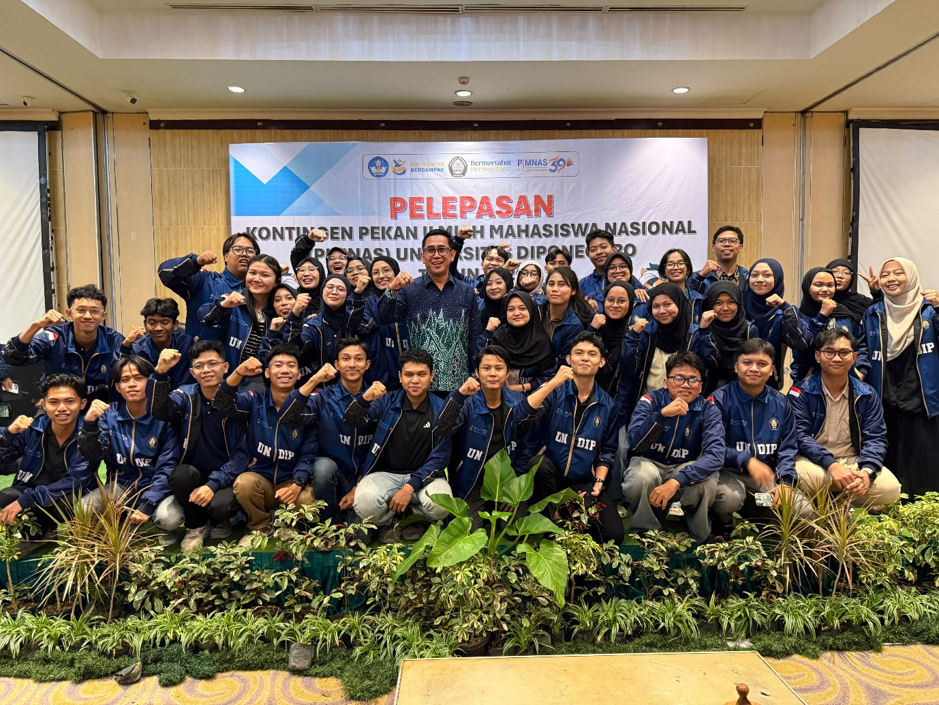
The Faculty of Science and Mathematics (FSM), Universitas Diponegoro (UNDIP), has once again achieved a remarkable milestone, with eight Student Creativity Program (PKM) teams led by FSM UNDIP students qualifying for the 39th National Student Scientific Week (PIMNAS) in 2026. These eight teams are among UNDIP’s 24 delegations participating in the national competition, held from November 2 to 7, 2026, at Universitas Diponegoro, Semarang.
The eight FSM UNDIP teams consist of five teams from the Chemistry Study Program, two from Physics, and one from Informatics. Their innovations cover advanced materials, healthcare, alternative energy, and artificial intelligence-based technologies. This achievement highlights the contributions of FSM UNDIP students in developing scientific research and innovations capable of competing at the national level.
Send-Off Ceremony for UNDIP’s 39th PIMNAS Delegation
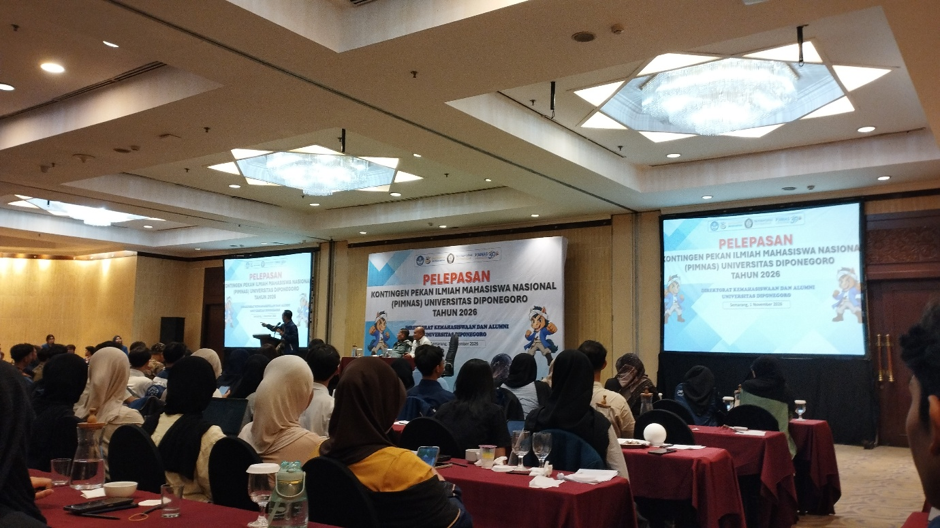
To demonstrate its support for the finalists, Universitas Diponegoro held a send-off ceremony for its 39th PIMNAS delegation on Sunday, November 1, 2026, at the Grand Candi Hotel, Semarang. The event was attended by university leaders, supervising lecturers, and student delegates representing UNDIP.
The Rector of UNDIP, Prof. Dr. Suharnomo, S.E., M.Si., expressed his appreciation for the achievements of the 24 UNDIP teams that qualified for the final round, placing the university among the top three institutions nationwide in terms of the number of PIMNAS delegations. In his remarks, the Rector encouraged students to embrace the fighting spirit of Prince Diponegoro, thoroughly prepare their ideas, and demonstrate confidence throughout the competition.
Meanwhile, UNDIP’s Vice Rector for Academic and Student Affairs, Prof. Dr.rer.nat. Ir. Heru Susanto, S.T., M.M., M.T., reminded all delegates to maintain their focus, stamina, and enthusiasm to deliver their best performances at the 39th PIMNAS.
Eight FSM UNDIP PKM Teams Qualify for the 39th PIMNAS
According to the delegation list, eight teams led by FSM UNDIP students qualified in three PKM categories: six Exact Sciences Research projects (PKM-RE), one Creative Innovation project (PKM-KC), and one Entrepreneurship project (PKM-K).
The eight qualifying teams are as follows:
1. PKM-RE – Integration of Graphene Quantum Dots Derived from Styrofoam Waste with Carbon Nanotubes to Enhance Conductivity and Lithium-Ion Diffusion in LiMnFePO₄ Cathodes
- Team Leader: Irgi Maulana Hakim
- Members: Giska Wulan Sari, Alia Naina Herdiana, and Puput Triandari
- Supervising Lecturer: Nor Basid Adiwibawa Prasetya, S.Si., M.Sc., Ph.D.
2. PKM-RE – Development of Nitrogen-Doped Graphene Quantum Dots Derived from Candlenut Shells as Fluorescent Probes for Breast Cancer Cell Bioimaging
- Team Leader: Nur Afni Aulia
- Members: Syadzwina Ratnamaya Hady, Gwenda Aris Amanta, and Intan Regita Cahyani
- Supervising Lecturer: Nor Basid Adiwibawa Prasetya, S.Si., M.Sc., Ph.D.
3. PKM-KC – Prototype of a Wearable ECG Device Based on Edge AI Using a 1D-CNN Algorithm for Early Detection of Arrhythmias
- Team Leader: Muhammad Fikri
- Members: Athaya Rashif Hanang Syah, Rizqika Azkiya Algim, Raffi Arditama, and Rafa Azlan
- Supervising Lecturer: Guruh Aryotejo, S.Kom., M.Sc.
4. PKM-RE – Development of a PET Microplastic Nanosensor Agent Based on Nitrogen-Doped Carbon Quantum Dots Derived from Rice Husks for Laundry Wastewater Detection
- Team Leader: Rizky Rahmad Danu Saputra
- Members: Nur Kholis Majid, Muhammad Rijal Fadil Akbar, Muhammad Raihan Ardiansyah, and Sophie Maulida
- Supervising Lecturer: Dr. Suci Faniandari, S.Pd., M.Si.
5. PKM-RE – Development of Dissolvable Centella asiatica Microneedle Patches Based on Blue Light-Activated Crosslinked Gelatin Methacrylate for Diabetic Ulcer Therapy
- Team Leader: Salma Palupi Dwi Purwati
- Members: Devina Rahmadhani, Riskia Khanifa, Alia Fadzilatun Nisa, and Amanda Suwesti Ekasida
- Supervising Lecturer: Nor Basid Adiwibawa Prasetya, S.Si., M.Sc., Ph.D.
6. PKM-RE – Innovation of a Non-Enzymatic Glucose Sensor with an Optimized Composition Based on ZnO Nanocomposites Derived from Citrus limon Peels and Reduced Graphene Oxide from Coffee Grounds
- Team Leader: Hasan Miftahudin
- Members: Ahbar Ramadhani, David Auza Sitanggang, and Matahelumual Mohican Giornando
- Supervising Lecturer: Dr. Erik Bhekti Yutomo, S.Si., M.Si.
7. PKM-K – GENARI: Low-Emission Solid Bioethanol Fuel Based on Fermented Biomass to Reduce Indonesia’s Dependence on Imported Oil and Gas Fuels
- Team Leader: Bayu Saputra
- Members: Muhammad Daffa Amru, Cyrilla Nadya Azizah, Rafa Tamlikha Efendi, and Nafisa Auliana Putri Andini
- Supervising Lecturer: Nor Basid Adiwibawa Prasetya, S.Si., M.Sc., Ph.D.
8. PKM-RE – Synthesis and Modification of SnO₂ Nanocomposites Dispersed on Reduced Graphene Oxide Derived from Styrofoam Waste as High-Performance Lithium-Ion Battery Anodes
- Team Leader: Okhan Dimas Pramudya
- Members: Anindya Rahma Aulia, Imam Manggarai Samman, Farah Nur Ramadani, and Nurun Nasywa Imtiyaaz
- Supervising Lecturer: Nor Basid Adiwibawa Prasetya, S.Si., M.Sc., Ph.D.
Strengthening the Spirit of Student Research and Innovation
The success of eight FSM UNDIP teams in advancing to the 39th PIMNAS represents another important achievement in fostering student creativity and innovation. Previously, 11 FSM UNDIP student teams had also secured PKM funding in 2026, reflecting the faculty’s continued commitment to promoting a research culture and developing innovative projects.
As the host of the 39th PIMNAS, UNDIP is committed to providing excellent services and facilities for participants from universities across Indonesia. FSM UNDIP also supports the competition and expresses its appreciation to the students and supervising lecturers who have contributed to the teams’ preparations.
Through their participation in the 39th PIMNAS, FSM UNDIP hopes that all teams will achieve outstanding results, bring pride to the faculty and university, and inspire other students to continue creating innovative solutions that benefit society.