
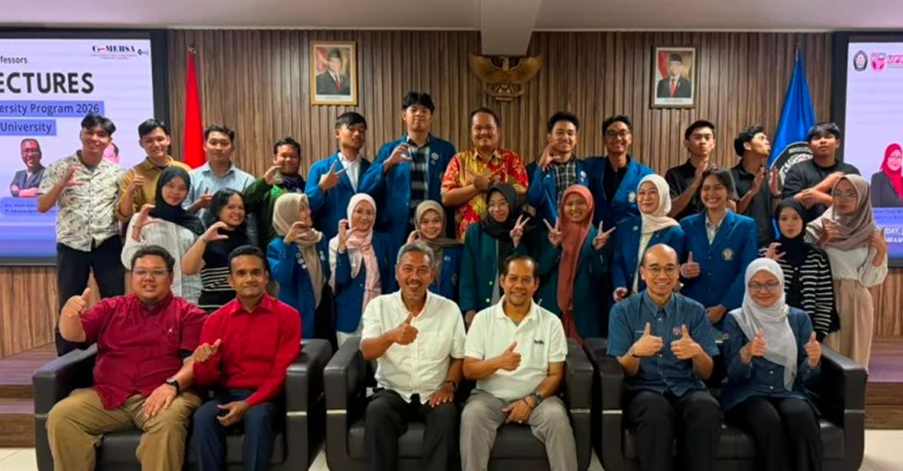
The Faculty of Science and Mathematics, Universitas Diponegoro (FSM UNDIP), organized the Adjunct Professor Program from June 16–22, 2026, as part of its efforts to strengthen academic internationalization and support Universitas Diponegoro’s achievement as a World Class University (WCU). The program featured Prof. Dr. Natrah Fatin from the Department of Aquaculture, Faculty of Agriculture, Universiti Putra Malaysia (UPM), who is also the founder of the Algae-Biota Technology and Innovation Group (ALBIC), as a visiting professor. The activity also involved Prof. Dr. Razif Harun from the Department of Chemical Engineering, Faculty of Engineering UPM, as well as Drs. Imam Kadarisman, M.Si., President Commissioner of PT Rekayasa Agromarin Indonesia.
The Chair of the Adjunct Professor Program Organizing Team, Prof. Dr. Sapto Purnomo, M.Si., Ph.D., stated that the program was a strategic initiative aimed at strengthening international academic networks, improving the quality of research and reputable publications, expanding multidisciplinary collaborations, and supporting Universitas Diponegoro’s performance indicators at the global level. During the seven-day program, various academic activities, research, innovation, industry and government collaborations, as well as cultural diplomacy initiatives, were successfully integrated into one interconnected series of programs.
The activities were conducted across Universitas Diponegoro, the Center of Marine Ecology and Biomonitoring for Sustainable Aquaculture (Ce-MEBSA), PT Alga Bioteknologi Indonesia (ALBITEC), the Brackish Water Aquaculture Fisheries Center (BBPBAP) Jepara, Marine Science Techno Park (MSTP), and several cultural heritage areas in Central Java. The program also involved a number of academics and researchers, including Erwin Adriono from the Department of Computer Engineering, Faculty of Engineering UNDIP, who focuses on the application of Internet of Things (IoT) technology for sustainable aquaculture, Dr. Fuad Muhammad, M.Si. from the Master’s Program in Environmental Science UNDIP with expertise in coastal management and marine ecology, and Dr. Mohammad Abdur Rahman Miah, Associate Professor in Zoology and Assistant Director (Planning & Development) at the National Academy for Educational Management (NAEM), Dhaka.
One of the main agendas of the program was the Manuscript Clinic, which provided intensive mentoring for lecturers and postgraduate students in strengthening scientific novelty, research methodology, data analysis, academic writing quality, and publication strategies for reputable international journals. Through this activity, several collaborative manuscript drafts were successfully prepared for submission to Scopus Q1-indexed international journals. The program also became an important momentum for developing international collaborative research under the theme Sustainable Use of Microalgae for Human Well-being, focusing on functional food based on microalgae, aquaculture biotechnology, environmental biomonitoring, circular bioeconomy, and sustainable aquaculture systems.
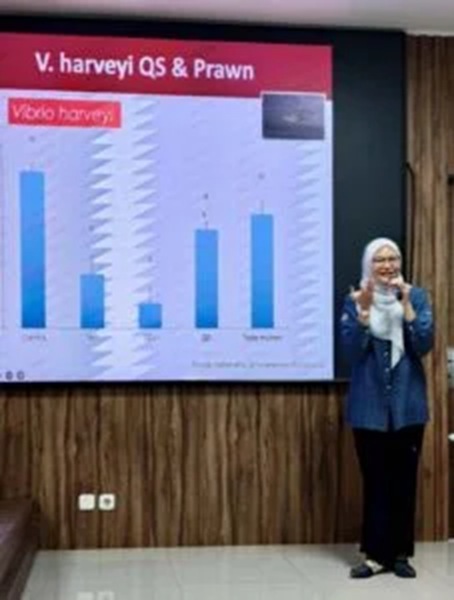
Academic discussions throughout the program resulted in collaborative publication plans as well as preliminary frameworks for collaborative research proposals that are planned to be submitted to various international funding schemes, such as UK Research and Innovation (UKRI), Toyota Foundation, The World Academy of Sciences (TWAS), Australia Research Council (ARC), Tanoto Foundation, and various other international funding institutions. To support the internationalization of learning, Prof. Dr. Natrah Fatin also delivered a guest lecture entitled “Applied Biology and Innovation to Support Sustainable Aquaculture,” attended by lecturers, students, and researchers. The activities continued with a Focus Group Discussion (FGD) and international scientific publication strategy training, providing insights into developments in applied biology, aquaculture technology innovation, and cross-country collaborative research development.
Strengthening partnership networks through a quadruple helix approach also became one of the program’s strategic achievements. Together with PT Alga Bioteknologi Indonesia (ALBITEC), discussions were conducted regarding downstream microalgae research, photobioreactor development, and opportunities for collaboration in research, education, and international funding. Meanwhile, through visits and benchmarking activities at BBPBAP Jepara, participants gained insights into various leading facilities that support productive and sustainable aquaculture systems, ranging from hatcheries, fish breeding and rearing units, natural feed production, pellet production facilities, to modern aquaculture infrastructure.
The Adjunct Professor Program also showcased one of Universitas Diponegoro’s leading innovations through a field visit to the KJABB–Integrated Multi-Trophic Aquaculture (KJABB–IMTA), developed by Ce-MEBSA as a modern marine cultivation model based on an ecological approach. During the visit, participants were introduced to the implementation of the Integrated Multi-Trophic Aquaculture (IMTA) concept, Internet of Things (IoT)-based real-time environmental monitoring systems, biomonitoring and biosecurity using biological indicators, as well as ecological engineering to improve production efficiency while maintaining the sustainability of coastal ecosystems. In addition to academic and research activities, the program also integrated cultural diplomacy through visits to historical and cultural heritage sites in Central Java as an effort to introduce Indonesia’s cultural richness to international partners.
Overall, the FSM UNDIP Adjunct Professor Program successfully strengthened collaboration among Universitas Diponegoro, Universiti Putra Malaysia, Ce-MEBSA, ALBIC, PT ALBITEC, and BBPBAP Jepara, while also enhancing readiness for international scientific publications, expanding global funding networks, and strengthening synergy among universities, government institutions, industries, and society. The program also involved 25 undergraduate Biology students from FSM UNDIP across various semesters and four student representatives from the Department of Aquaculture, Faculty of Fisheries Science and Aquaculture (FSPA), Universiti Malaysia Terengganu (UMT), Malaysia.
Further coverage of this activity has been published by the media and can be accessed through the following link: