
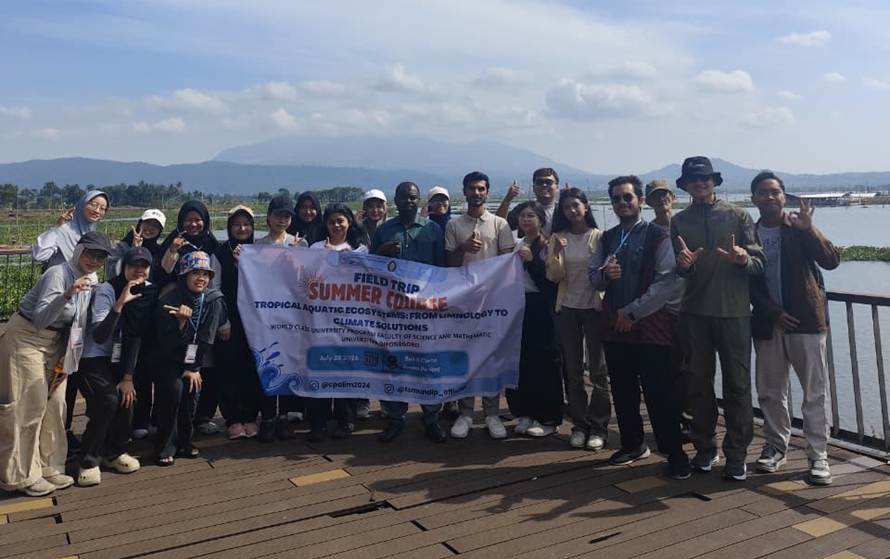
The Faculty of Science and Mathematics (FSM), Universitas Diponegoro, through the Cluster for Paleolimnology (CPalim), successfully organized the Tropical Aquatic Ecosystems Summer Course 2026: From Limnology to Climate Solutions. This international academic program was designed to strengthen global collaboration and interdisciplinary learning in the field of freshwater ecosystem science.
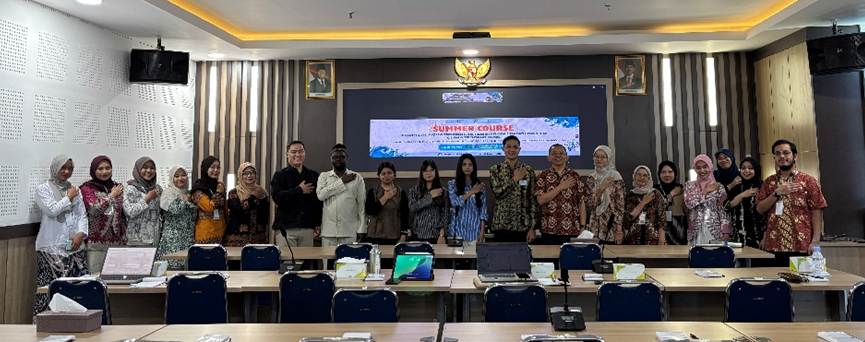
Held from July 24 to July 31, 2026, the program attracted 35 registered participants from Indonesia and several other countries, including Pakistan, Tanzania, Kenya, Nigeria, Mali, Egypt, Kyrgyzstan, Bangladesh, India, Malaysia, and Yemen. The participants came from diverse academic backgrounds, including biology, fisheries, environmental science, engineering, public health, and other related disciplines.
The Summer Course formed part of Universitas Diponegoro’s commitment to strengthening internationalization and realizing its vision of becoming a world-class university. Through the program, participants had the opportunity to broaden their knowledge, establish international academic networks, and develop a deeper understanding of sustainable freshwater ecosystem management.
The program highlighted the importance of tropical freshwater ecosystems as some of the world’s most valuable natural resources. At the same time, these ecosystems face various environmental challenges, including biodiversity loss, eutrophication, declining water quality, sedimentation, and the impacts of climate change.
Through an interdisciplinary approach, participants explored how scientific research can contribute to sustainable ecosystem management and support evidence-based environmental decision-making. Academic sessions were delivered by national and international experts with expertise in limnology, ecology, climate change, and environmental monitoring.
One of the sessions discussed the limnology of Rawapening Lake, including its ecological dynamics and the environmental challenges faced by one of Indonesia’s nationally prioritized lakes. A session on global networking and international collaboration was delivered by Assoc. Prof. Łukasz Kruszewski from the Institute of Geological Sciences, Polish Academy of Sciences. In his presentation, he explained various opportunities for building scientific partnerships and conducting collaborative research at the international level.
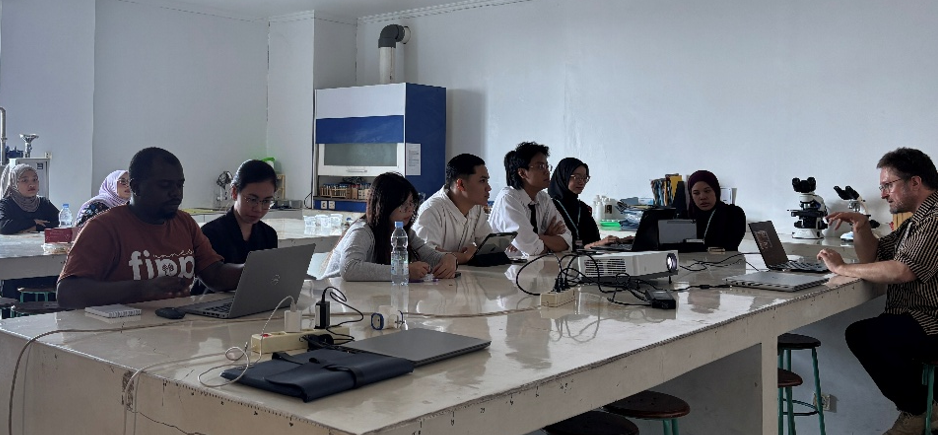
Participants also received material on carbon stock assessment in aquatic ecosystems. The session emphasized the role of freshwater ecosystems in climate change mitigation through their capacity to store and regulate carbon.
In addition, a session on vegetation analysis for ecosystem monitoring introduced the importance of plant communities as indicators of ecological conditions. Meanwhile, the session on the application of environmental DNA, or eDNA, in lake ecosystems introduced modern molecular approaches for monitoring biodiversity and assessing the condition of aquatic ecosystems.
In addition to classroom-based learning, participants gained direct experience through freshwater ecosystem observations at Rawapening Lake. Under the guidance of experts, they observed biodiversity, aquatic vegetation, plankton, diatoms, and environmental conditions around the lake.
Laboratory activities also provided participants with experience in sample processing, environmental monitoring techniques, and the use of modern approaches in aquatic ecosystem research. These activities offered a more comprehensive understanding of the relationship between field observations, laboratory analysis, and the interpretation of scientific data.
One of the main strengths of the program was its emphasis on interdisciplinary collaboration. The discussions demonstrated that addressing freshwater environmental issues requires not only contributions from natural scientists, but also the involvement of engineers, educators, policymakers, legal experts, economists, and communication practitioners.
This approach encouraged participants to understand that each discipline plays a complementary role in achieving sustainable environmental management. The Summer Course concluded with participant presentations that integrated field observations, laboratory experiences, and scientific discussions into practical recommendations for freshwater ecosystem conservation.
Through the organization of the Tropical Aquatic Ecosystems Summer Course 2026, FSM Universitas Diponegoro continues to strengthen its role as a center for education, research, and global collaboration in aquatic ecosystem science. The program also reflects Universitas Diponegoro’s commitment to internationalization, academic excellence, and the development of future researchers capable of addressing global environmental challenges through innovative and interdisciplinary approaches.